


Gender equality

“Sustainable antimicrobial stewardship requires coordinated, context-specific strategies that strengthen animal health systems, regulate supply chains, and align incentives across the livestock sector.”
Background:
Antimicrobial resistance (AMR) is one of the defining health threats of our time, contributing to nearly 5 million deaths globally each year. A major driver of this crisis is in livestock production, which accounts for approximately two-thirds of all antimicrobial use (AMU) worldwide. As livestock systems expand rapidly (particularly in low- and middle-income countries) antimicrobial consumption is projected to increase, accelerating the spread of resistant bacteria that threaten animal, human and environmental health.
International organizations like the World Health Organization, Food and Agriculture Organization, and World Organisation for Animal Health (WOAH) have called for urgent action to promote responsible antimicrobial use in livestock. However, despite growing political attention, important questions remain about which policy interventions are most effective, how they are implemented across different contexts, and what barriers limit their success.
Existing evidence on livestock antimicrobial stewardship policies remains fragmented and unevenly distributed globally.
This project was developed to help address these gaps by synthesizing available evidence and identifying practical policy pathways that can support more effective and context-sensitive antimicrobial stewardship strategies.
What We Did:
This project combined a systematic review and evidence map with interviews with policy experts across five WOAH regions; specifically, Africa, Americas, Asia and the Pacific, Europe, Middle East to identify practical policy pathways, implementation barriers, and context-specific considerations for stewardship policy development.
Government policy interventions to reduce veterinary antimicrobial consumption in production animals: a systematic review and evidence map
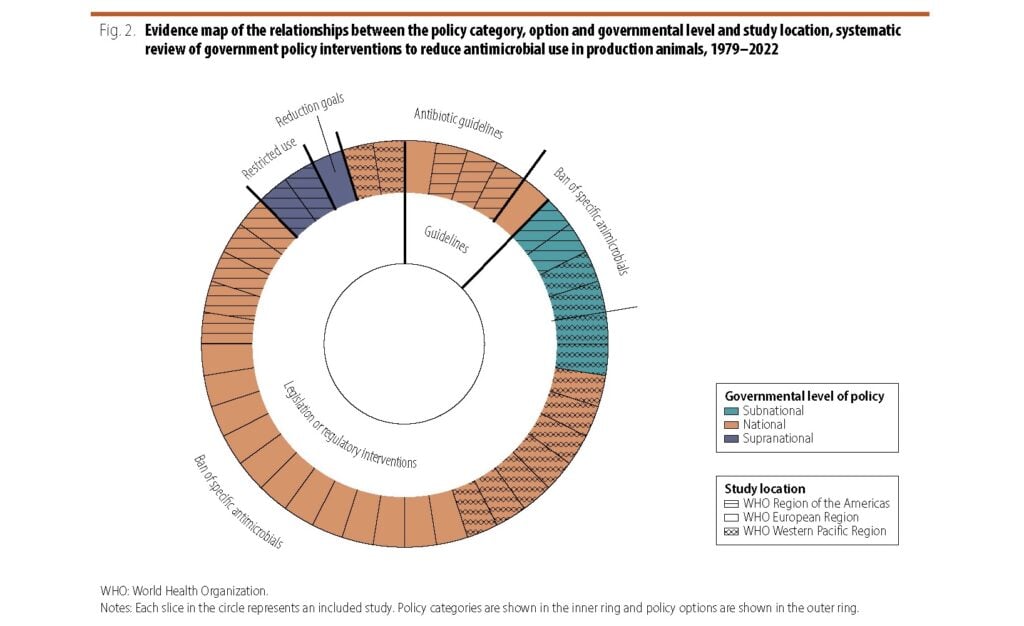
We conducted a systematic review and evidence map examining government policy interventions aimed at reducing antimicrobial use and antimicrobial resistance in production animals. The review analyzed 40 studies evaluating interventions including antimicrobial bans, prescription policies, stewardship guidelines, and reduction targets across multiple regions and production systems.
This study revealed not only what works, but more importantly, where evidence gaps exist.
Policy pathways for improving prudent and responsible use of antimicrobials in livestock: an expert-informed conceptual framework
This manuscript currently under submission for peer-reviewed publication.
To fill these evidence gaps, we then conducted interviews with 12 antimicrobial resistance policy experts (people working on the ground implementing and evaluating policies in diverse country contexts) across the world, representing all of the WOAH regions. We asked them what are countries actually trying? What barriers do they face? What works in different settings? Using the Behaviour Change Wheel framework, we synthesized their insights with targeted literature to develop a practical conceptual framework.
Project Outcome
Together these studies identified key evidence gaps, implementation barriers, and practical policy pathways that can help support more sustainable and effective antimicrobial stewardship in livestock production systems globally.
Key Findings
- Across the systematic review, all studies assessing antimicrobial use reported reductions following policy implementation, with some interventions reducing antimicrobial use by 20–80% and nearly eliminating specific high-priority antimicrobials in certain contexts.
- Regulatory and legislative tools (bans, restrictions, and prescription policies) are widely used but often limited by weak enforcement, outdated laws, and fragmented governance.
- Strengthening veterinary access, diagnostics, vaccination, surveillance, and was seen as central to reducing antimicrobial reliance in livestock systems. Policy experts consistently highlighted the importance of strengthening animal health systems alongside supply chain regulations and aligning incentives across the livestock sector.
- Policies must be tailored to local agricultural systems, governance structures, veterinary infrastructure, and economic realities. Interviewed experts cautioned against directly transferring policies between countries without adaptation to local contexts and capacities
- Most evaluated interventions were concentrated in high-income countries, with limited evidence from low- and middle-income settings. There were zero studies from Africa or the Middle East.
Our Solution
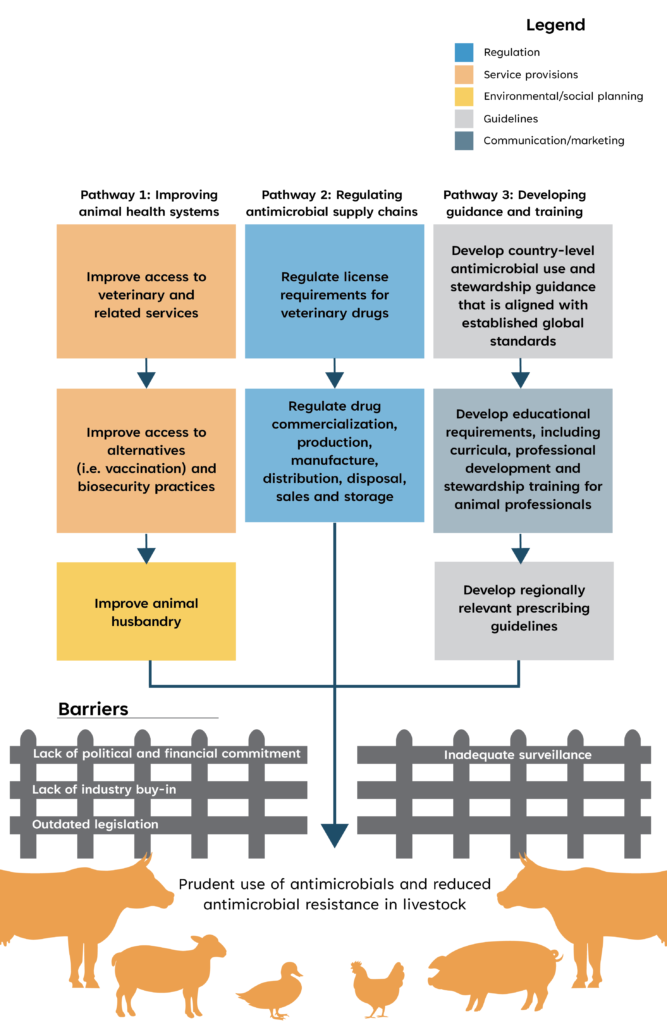
We created a practical conceptual framework that maps commonly used antimicrobial stewardship initiatives in livestock into three clear policy pathways:
Pathway 1: Strengthening Animal Health Systems
Improving access to veterinary services, vaccination, biosecurity and animal husbandry.
Pathway 2: Regulating Antimicrobial Supply Chains
Regulating license requirements for veterinary drugs, drug commercialization, production, manufacture, distribution, sales and storage
Pathway 3: Promoting Guidance, Training & Stewardship
Developing country level guidance that aligns with global standards, designing educational requirements for animal professionals on AMR, developing regionally relevant prescribing guidelines
 Previous