



Publication: Government policy interventions to reduce veterinary antimicrobial consumption in production animals: a systematic review and evidence map
Authors: Fiona Emdin, Kayla Strong, Jaskeerat Singh, Daniela Corno, Susan Rogers Van Katwyk, Heather Ganshorn, Arne Ruckert, Jeremy Grimshaw & Mathieu JP Poirier.
Introduction
This systematic review and evidence map of government policy interventions was aimed at reducing veterinary antimicrobial use (AMU) and antimicrobial resistance (AMR) in production animals. One of the drivers of global AMR, which contributes to millions of human deaths annually, is the two-thirds of antimicrobial use that occurs in production animal systems. Despite international calls from organizations such as the World Health Organization (WHO), Food and Agriculture Organization (FAO), and World Organization for Animal Health (WOAH) for responsible veterinary antimicrobial use, evidence on the effectiveness of government policies to reduce antimicrobial use and resistance in production animals remains limited. Existing reviews tend to focus on specific species, production systems, or policy types, leaving significant gaps in our understanding of the full range of interventions governments have implemented.
To address this knowledge gap, we conducted a systematic review and evidence mapping to:
- Identify and describe government policy interventions aimed at reducing antimicrobial use and resistance in production animals; and
- Map these interventions to highlight evidence gaps and inform future policy design.
By synthesizing available evidence, this work provides a foundation for governments, public health agencies, and researchers to develop, implement, and evaluate effective interventions that can curb AMR while safeguarding animal health and food security.
What we found:
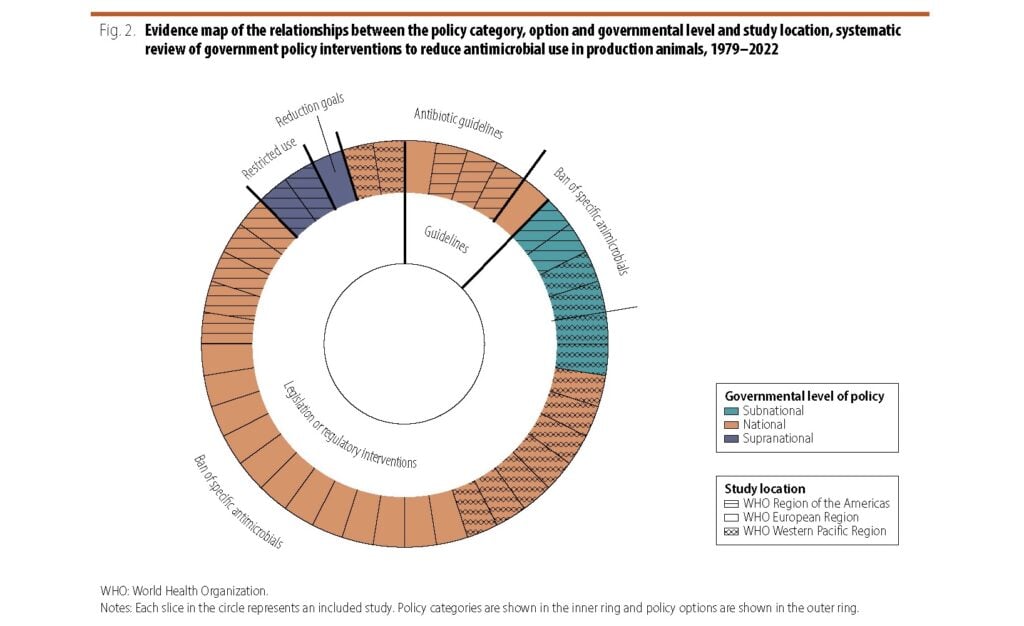
- Studies and regions: 40 studies were included, primarily from the WHO European Region, Region of the Americas, and Western Pacific Region. No eligible studies were found from the African or Eastern Mediterranean Regions.
- Policy types: Most interventions were legislative or regulatory (35/40), mainly bans or restrictions on specific antimicrobial uses (26/40), and a smaller number were guideline-based (6/40) or reduction targets (1/40).
- Impact on antimicrobial use (AMU) in animals: 14 studies assessed AMU, all reporting reductions in use ranging from 20–80%, with some interventions nearly eliminating certain high-priority antimicrobials.
- Impact on antimicrobial resistance (AMR) in animals: 28 studies assessed AMR, with 14 reporting reductions. Significant declines were observed, e.g., glycopeptide-resistant Enterococcus faecium in Danish pigs dropped from 70–90% to <10% after avoparcin bans. However, results varied by antimicrobial and pathogen and in some cases, resistance persisted or increased despite reduced AMU.
- Impact on AMR in humans: 9 studies examined downstream effects on human AMR. Bans on colistin in China and oxytetracycline in Germany were associated with reductions in resistance genes or resistant bacterial isolates in humans. Some U.S. regulations showed limited or mixed effects on human AMR.
- Study quality: Most studies (75%) were at high risk of bias, primarily due to uncontrolled before-after designs, confounding variables, and heterogeneity in outcome measures. Four studies were critical risk, and six were moderate risk.
- Evidence gaps: Few robust evaluations exist, especially in low- and middle-income countries. We did not identify any studies from African or Middle Eastern Regions. We also found there is limited long-term follow-up, inconsistent measurement of outcomes, and underrepresentation of industry-led or voluntary interventions.
Recommendations
- Expand and diversify policy evaluations: Governments, particularly in low- and middle-income countries, should implement and rigorously evaluate interventions targeting AMU and AMR in production animals.
- Standardize outcome measures: Establish consistent methods for measuring AMU and AMR in animals and humans to allow comparability across studies.
- Use robust study designs: Controlled before-after, interrupted time series, or randomized designs with longer follow-up periods are needed to reliably assess intervention impacts.
- Address multiple selective pressures: Policies should target multiple antimicrobial classes simultaneously to achieve reductions in resistance across pathogens.
- Encourage transparency and knowledge sharing: Countries should publicly report policy evaluations to facilitate international policy learning and adaptation.
- Integrate enforcement mechanisms: Success is enhanced when interventions include monitoring systems, penalties for non-compliance, and accessible veterinary oversight.
Conclusion
- Government policymakers and regulatory agencies could use this evidence to design effective, enforceable interventions that reduce AMU and AMR in production animals.
- Public health organizations (e.g., WHO, FAO, WOAH) can use these findings to guide One Health strategies and prioritize regions where evidence is lacking.
- Researchers and academic institutions should focus on generating methodologically robust evaluations and addressing evidence gaps in low- and middle-income countries.
While our targeted literature review provided valuable insights into antimicrobial use (AMU) policies in livestock, it revealed substantial evidence gaps, particularly regarding low- and middle-income countries (LMICs), where rapidly developing livestock systems face unique socioeconomic, infrastructural, and regulatory challenges. To better understand real-world policy initiatives, their implementation barriers, and context-specific feasibility, we then conducted semi-structured interviews with 12 AMR policy experts from all five World Organization for Animal Health regions as part of the Vet Policy Pathways project.
 Previous