


Background
Antimicrobial resistance (AMR) threatens our ability to treat infectious diseases in humans, animals, plants, and the environment around the world. To address this issue, we must take a One Health approach, which promotes collaboration across human, animal, plant, and environmental health sectors.
Specifically, One Health governance is comprised of the structures, processes, and mechanisms that enable and support the coordination and collaboration between these sectors, as well as with actors outside of the government, such as those in the private sector, academia, healthcare, and civil society.
While existing literature has identified important factors for effective One Health governance, it provides little guidance for how different country contexts like funding constraints, existing infrastructure and the type of government may impact AMR outcomes. That is why we approached this work through a context-specific lens.
GSL’s AMR Policy Accelerator is laying the building blocks to close this knowledge gap. Through a growing body of research, our project aims to deepen the evidence on how One Health Governance can be designed and implemented to fit diverse contexts, equipping policymakers, international organizations and researchers with the knowledge they need to respond to AMR effectively.
Our Research and Findings:
This is a mixed-methods study carried out in three phases, with each phase building on the one before it.
Implementing One Health Governance Approaches to Mitigate Antimicrobial Resistance Across Institutional, Social, Economic, and Political Contexts
Authors: Chloe Clifford Astbury, Taylor Hecker, Jaskeerat Singh, Suzanne Naro, Lauren Wallace, Geneviève Boily-Larouche, Yahaya Ahmed, Anand Balachandran, Zlatina Dobreva, Walter Fuller, Laetitia Gahembare, Yidnekachew Mazengiya, Bassim Zayed, Mathieu J. Poirier, Arne Ruckert
In this phase, we mapped the range of One Health governance mechanisms implemented around the world and identified common actors involved. We also examined how performance of One Health governance is conceptualized and measured, and identified key barriers and facilitators.
Key findings:
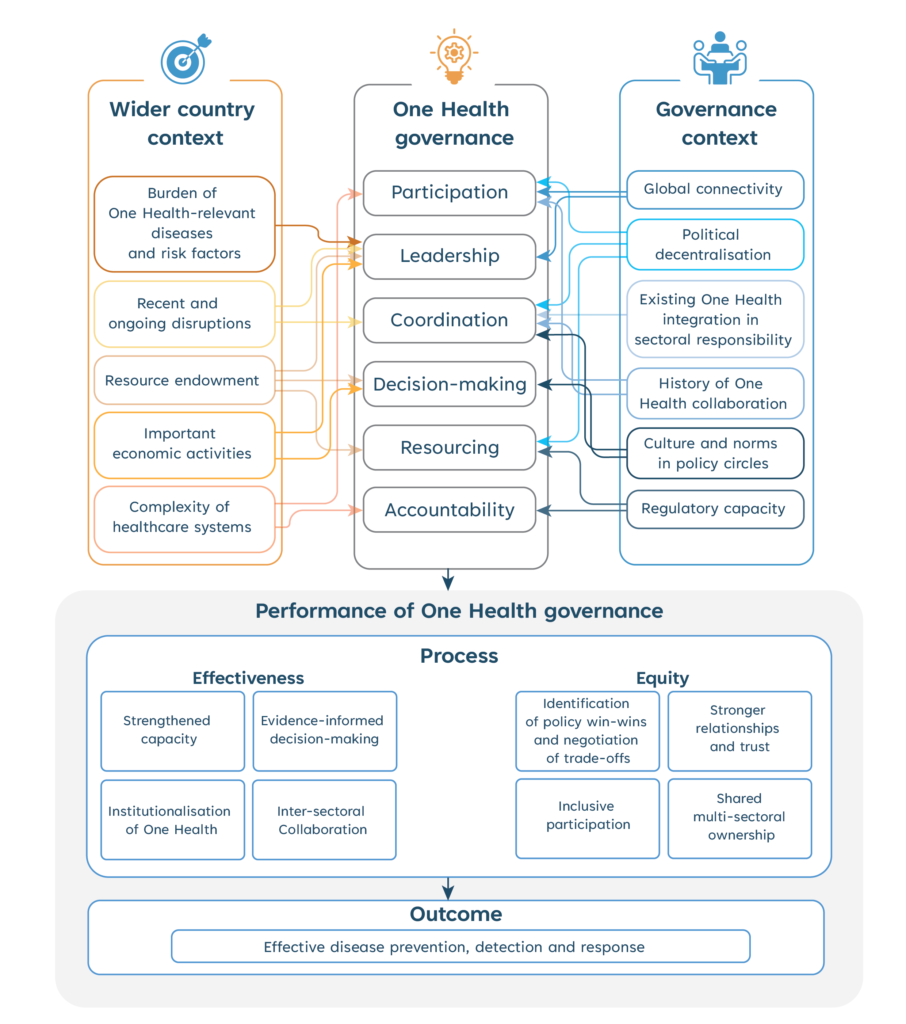
We identified six core governance dimensions central to One Health governance success:

Participation: Who is involved and how meaningfully they engage

Leadership: Who drives the work, formally and informally

Coordination: How sectors work together

Decision-making: How are priorities set and whose voices count?

Resourcing: Where funding comes from and how it’s sustained

Accountability: How commitments are tracked and upheld
These dimensions were implemented across diverse contexts and were strongly shaped by existing governance structures and broader country conditions.
This work is currently under peer review.
In this phase, we used publicly available data through the Tracking Antimicrobial Resistance Country Self-assessment Survey (TrACSS), an annual global survey covering human health, animal health, food, agriculture and environment sectors, to identify One Health governance dimensions necessary for, or sufficient to, catalyze successful action to address AMR across high-, medium-, and low-resource settings.
Research in progress.
In this phase, we developed and undertook in-depth case studies illustrating how and why particular approaches to One Health governance for AMR are effective in different contexts
Join our Mailing List
Would you like to join the Global Strategy Lab’s mailing list to receive the latest updates on our research, new datasets, resources, and upcoming events? Sign up for our newsletter below:
 Previous