

Antimicrobials are vital tools for animal health professionals and for keeping animals healthy. But as antimicrobial resistance (AMR) grows, these drugs are becoming less effective, with consequences for the health of animals, people, plants, and the environment.
The updated Global Action Plan on Antimicrobial Resistance (GAP-AMR) 2026–2036 gives countries a roadmap for strengthening their National Action Plans on AMR through a One Health approach. A new policy brief from the Global Strategy Lab (GSL) shows how to put that plan into practice in livestock systems.
Policy Pathways for Antimicrobial Stewardship in Livestock Systems draws on our previous systematic review on government policies and interviews with AMR experts in animal health and stewardship. It offers policymakers pathways and recommendations that countries can build into their National Action Plans to strengthen animal health systems, antimicrobial governance and supply chains, and stewardship guidance and training in livestock systems.
Context matters and evidence shows that no single policy or fix alone will work the same everywhere. Coordinated packages of interventions, adapted to local contexts, are more likely to succeed. The brief groups these interventions into three pathways:
- Strengthening animal health systems, through veterinary access, diagnostics, vaccination, biosecurity, and good farming practices.
- Strengthening antimicrobial governance and supply chains, through regulating how veterinary medicines are approved, produced, sold, and used.
- Strengthening guidance, training, and stewardship, through clinical guidelines, education for veterinarians, awareness campaigns, economic incentives, and national targets.
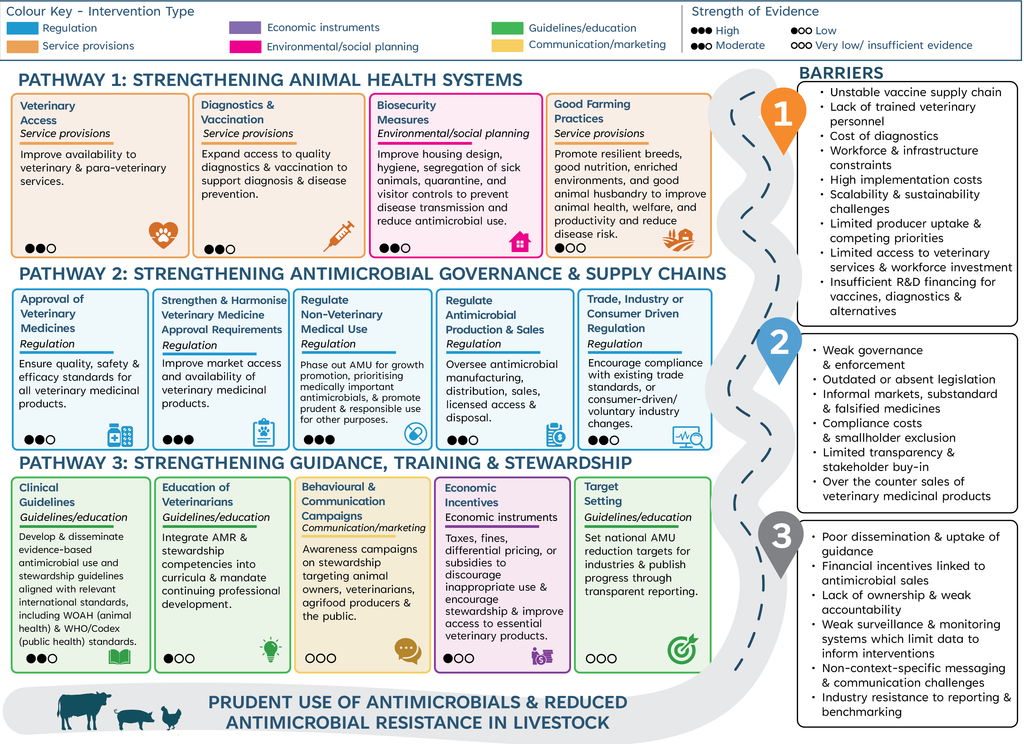
Successful policies consider and integrate local context, are backed by strong governance, are co-created with the people they affect, and have equity as a recurring theme, accounting for smallholder farmers, who often face higher costs and barriers than commercial operations.
“The key insight that seemed to come from all the experts that we interviewed was that none of these pathways or initiatives really work well in isolation… When you align regulations with strong infrastructure and clear guidance, then that’s when you’re going to have your most successful reductions in antimicrobial use.”
– Fiona Emdin, Global Strategy Lab
The brief brings five recommendations for National Action Plans:
- Strengthen regulatory frameworks for antimicrobial use, aligning national laws with WOAH standards, including restrictions on non-veterinary uses such as growth promotion.
- Prioritize disease prevention through vaccination and biosecurity, shifting toward prevention-first strategies that reduce the need for antimicrobials.
- Strengthen standardized surveillance and monitoring of AMR and antimicrobial use, including a One Health coordinating authority that links animal, human, plant, and environmental data.
- Strengthen monitoring and evaluation of stewardship policies and interventions, so countries can see what is working and track progress against their National Action Plans.
- Embed equity considerations in stewardship policies, so that measures do not place an unfair burden on smallholder producers and underserved communities.
The brief also flags where more research is needed. There is limited evidence on the cost-effectiveness of interventions, on how to support veterinarians whose income depends on antimicrobial sales, and on how taxes, fines, and subsidies affect smallholder farmers. Integrated One Health surveillance also remains limited in many countries.
“I believe [this policy brief] will be a very valuable tool for policymakers in their implementation of the updated GAP-AMR 2026-2036.”
– Dr. Emmanuelle Soubeyran, Director General of WOAH.
We hope the brief will help countries move from commitments to action, building livestock systems that protect animal health, farmers’ livelihoods, and the effectiveness of antimicrobials for generations to come.
Read the Brief
The brief was written by Fiona Emdin, Kayla Strong, Geneviève Boily-Larouche, Arne Ruckert, and Mathieu J.P. Poirier
 Previous