

tobacco control

Without gender-sensitive data and evidence, the tobacco control community risks stalling progress toward equitably achieving global health goals.
Background
The tobacco epidemic is one of the biggest public health threats we’ve ever faced, killing more than 7 million people each year. Despite being the leading cause of preventable death, tobacco control strategies remain fragmented and gender blind.
Although smoking rates are dropping for men and women in high-income countries, the number of smokers has increased in low-income settings since 1990 due to economic and population growth, and tobacco companies are actively undermining the adoption of stronger regulations.
The vast majority of tobacco control policies treat men and women smokers the same, ignoring deeper social, cultural, and economic drivers that shape smoking behaviours among men, women, and gender-diverse people, as well as their responses to tobacco control efforts. This oversight reinforces health inequities, especially where gender norms intersect with poverty and limited healthcare access.
This is why the Global Strategy Lab is building an open-access database of global gender-disaggregated cigarette smoking to help shape more equitable tobacco control interventions.
Key Findings
Closing this gap means more than disaggregating data by sex. It demands integrating gender-sensitive approaches in research and policies in a way that recognizes how gender actually shapes smoking behaviours, exposure to tobacco, and access to support for quitting.
We have conducted a series of studies beginning with structured reviews to understand how gender is integrated in tobacco research, and applying rigorous quantitative methods to understand gender differences in smoking among smokers worldwide:
- Only a handful of studies fully integrate a gender-sensitive approach in assessing the impact of tobacco control policies and interventions.
- We evaluated 43 studies using the European Institute for Gender Equality Framework (EIGE) and found that 16 studies assessed specific tobacco control policies, and only five evaluated the gender-specific impacts of these policies.
- Too many studies rely on binary comparisons that ignore gender dynamics, such as context-specific social and cultural drivers.
This work is currently under peer review.
This study systematically gathered global survey data from 172 countries and calculated the smoking intensity ratio, or the estimated number of cigarettes per day that men and women smoke on average. We then investigated whether gender differences in smoking behaviour are influenced by wealth, gender equity, or cultural factors.

International Gendered Cigarette Smoking Intensity Dataset (IGCSID)
Our team systematically collected nationally representative survey data from 172 countries, allowing us to estimate the average number of cigarettes men and women smoke per day.
Our data will be publicly available in an open-access dataset when the related study, currently under review with a journal, is published.

Gender-Disaggregated International Cigarette Consumption Dataset (G-ICCD)
We used a novel approach to disaggregate cigarette consumption data for men and women from 1990 to 2015 across 85 countries in the ICCD. The first iteration of the ICCD was previously developed through a landmark Global Strategy Lab study which outlined the process to collect, appraise, select, and report the best available national estimates of cigarette consumption from 1970 to 2015, resulting in a publicly accessible dataset.
Our updated gender-disaggregated data will also be made publicly available as an open-access dataset when the related study, currently under review with a journal, is published.

No Country Left Behind: Strengthening Global Tobacco Control
Join panelists Tina Nanyangwe-Moyo, Ouleymatou Diop, Les Hagen, Jaime Arcila and moderator Mathieu Poirier on this webinar about the importance of global research and strategies to address the tobacco epidemic and create a healthier, more equitable tobacco-free future.

Smoking Intensity, Gender and Contributing Factors, with Tina Nanyangwe-Moyo and Mehedi Hasan Rasel
In this seminar, Tina Nanyangwe-Moyo and Mehedi Hasan Rasel present their findings from the upcoming research paper on cigarette smoking intensity and gender.

GSL Researchers Attend World Conference on Tobacco Control
From June 23 to 25, GSL Researchers Lathika Laguwaran, Mehedi Hasan Rasel, and Director Mathieu JP Poirier attended the World Conference on Tobacco Control.
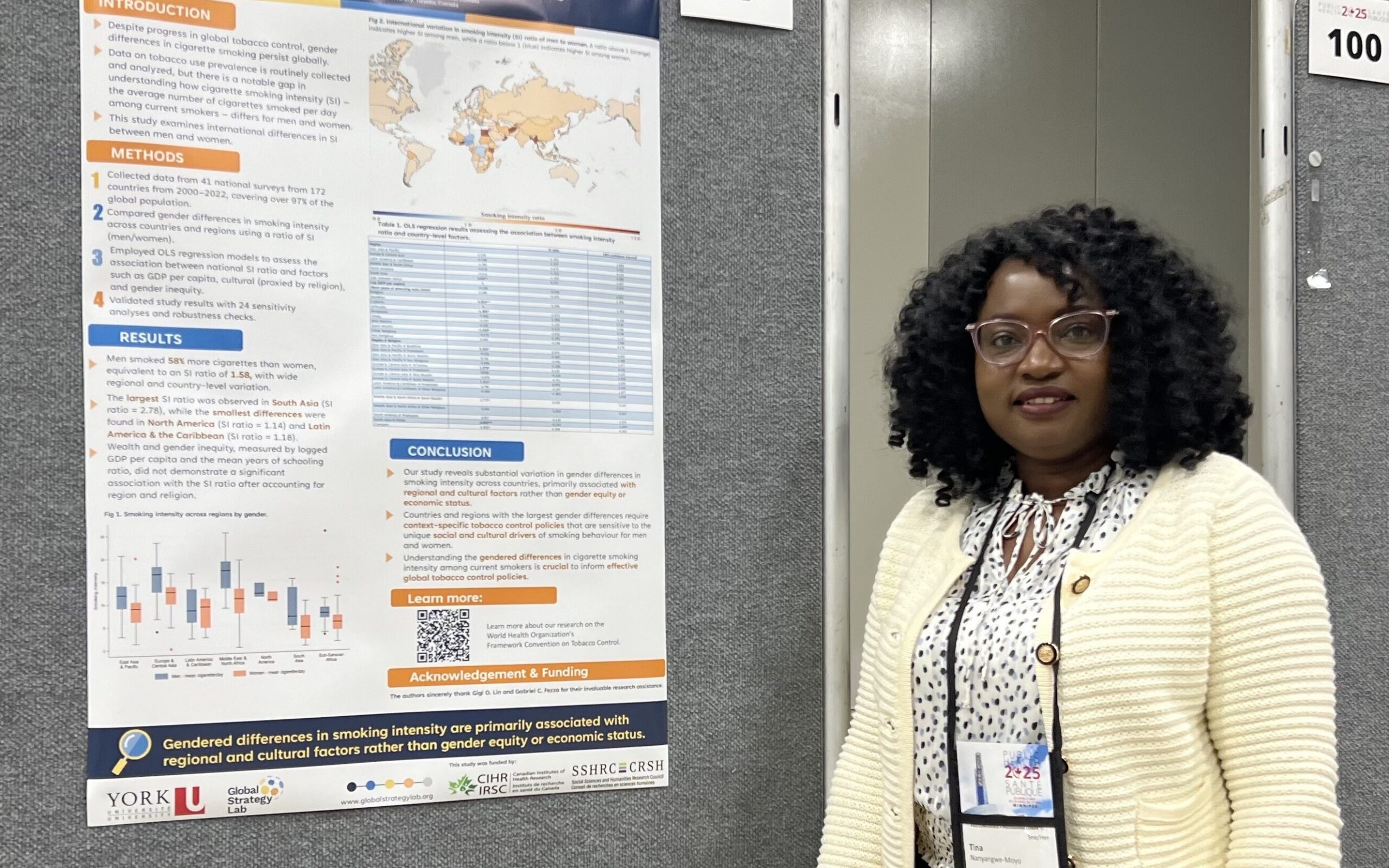
Poster Presentation at the Canadian Public Health Association Conference 2025
On April 28, GSL Investigator Tina Nanyangwe-Moyo presented a poster at CPHA 2025. The poster summarizes findings from the upcoming study examining gender differences in cigarette smoking intensity across 172 countries.
Join our Mailing List
Would you like to join the Global Strategy Lab’s mailing list to receive the latest updates on our tobacco control research, new datasets, resources, and upcoming events? Sign up for our newsletter below:
 Previous