

A 75-study analysis across 28 countries identifies the stakeholders, communication pathways, and barriers shaping antibiotic decisions in food-producing animal systems.
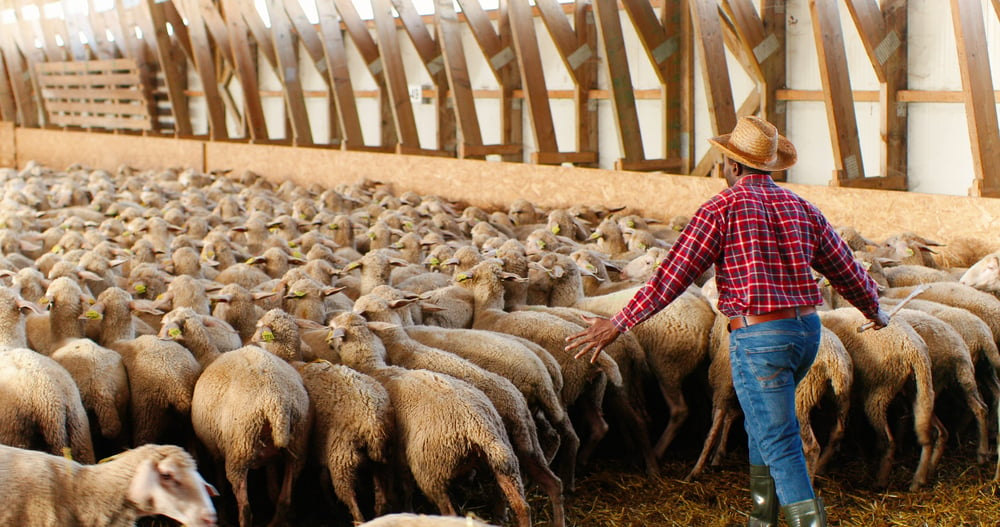
When farmers and livestock producers decide whether —and how— to use antibiotics, those decisions are rarely made alone. A newly published scoping review by researchers with the SAFE AMR Partnership reveals a complex network of actors, incentives, and information flows that shape antibiotic use in food animal production systems, with direct implications for how AMR policies and interventions should be designed.
Published on May 26, 2026, in One Health Outlook, the review was led by Carly Ching, Muhammad H. Zaman, and Veronika J. Wirtz at Boston University, and co-authored by Fiona Emdin and Sahran Shafaque at the Global Strategy Lab. The team screened nearly 6,000 records and ultimately included 75 peer-reviewed studies from 28 countries, published between the years 2000 and 2025.
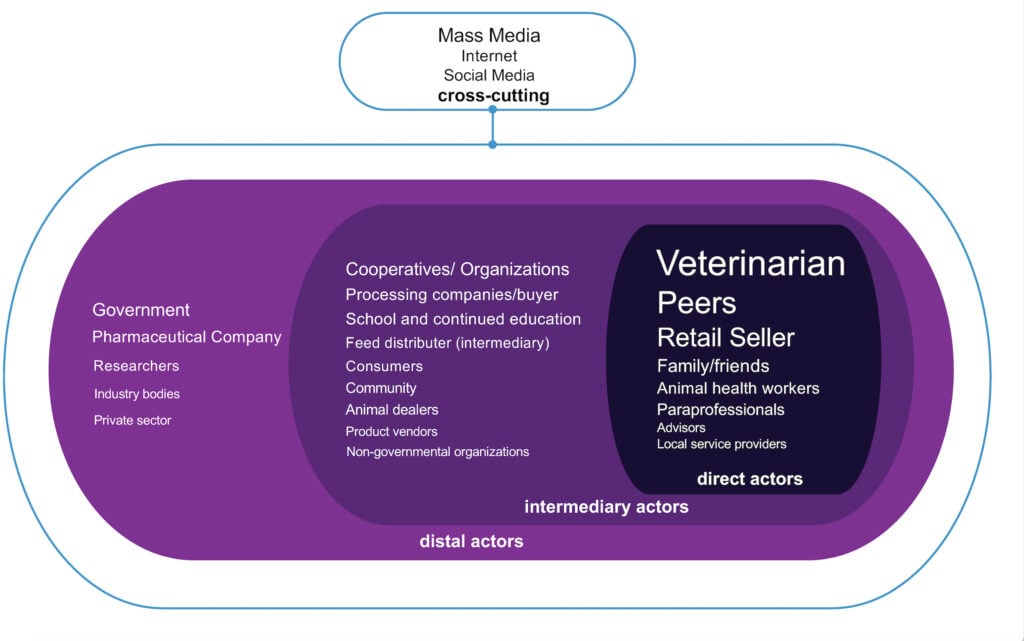
The review identified 25 distinct stakeholders who can influence farmers’ decisions about antibiotic use. Veterinarians were the most frequently cited source of advice, appearing in 86.7% of studies, followed by peers at 49.3%. Retail sellers were also identified as significant actors in 29.3% of contexts. Informal networks and financial incentives were found to sometimes promote inappropriate use, while cost and limited access were the most cited barriers to following guidance, flagged in 45.9% and 48.6% of studies, respectively.
Trust emerged as the leading facilitator, cited in 41.7% of studies, underscoring that the quality of relationships, not just the availability of information, can greatly impact whether guidance is applied in practice. The authors recommend strategies that address cost, improve access, and build trust, while tailoring approaches to local conditions and the specific roles of different actors in each context.
“This research gives policymakers and regulators a clearer picture of where to intervene. It’s not enough to produce good guidance. We need to understand who farmers actually trust and turn to, and work through those channels.”
— Fiona Emdin, Global Strategy Lab
This publication is part of the SAFE AMR Governance Partnership, funded through a Social Sciences and Humanities Research Council of Canada (SSHRC) Partnership Grant (#895-2022-1015) and coordinated by the Global Strategy Lab. The partnership brings together researchers across countries, institutions, and disciplines to examine and to better understand and address the root social processes, structures, and power dynamics that drive AMR, beyond what could be accomplished by any one country, centre, or discipline alone.
Read the publication here: One Health Outlook, Volume 8, Article 29 (2026)
Learn more about the SAFE AMR Governance Partnership.
 Previous