

On June 20, 2026, GSL’s Tina Nanyangwe-Moyo, Isaac Weldon, Chloe Clifford Astbury, Tarra L. Penney, A. M. Viens, Steven J. Hoffman, and Mathieu J. P. Poirier published new research advancing global legal epidemiology (GLE), an emerging field that studies how international laws, policies, and norms shape health, equity, and well-being around the world. The study, “Overcoming Challenges to Conducting Global Legal Epidemiology Research,” appears in Global Public Health.
Legal epidemiology is the scientific study of how laws shape health outcomes across a population. It treats law as a force that can drive, spread, or help prevent disease and injury, and applies that lens to understand and improve public health at a national level. When researchers scale that lens up to the global level, they are faced with new challenges.
Drawing on case studies, the research identifies these challenges alongside the strategies researchers have used to work through them, including differences in how countries report data, varied understandings of what it means to follow an international agreement, and the difficulty of measuring global impacts when there is no clear control group.
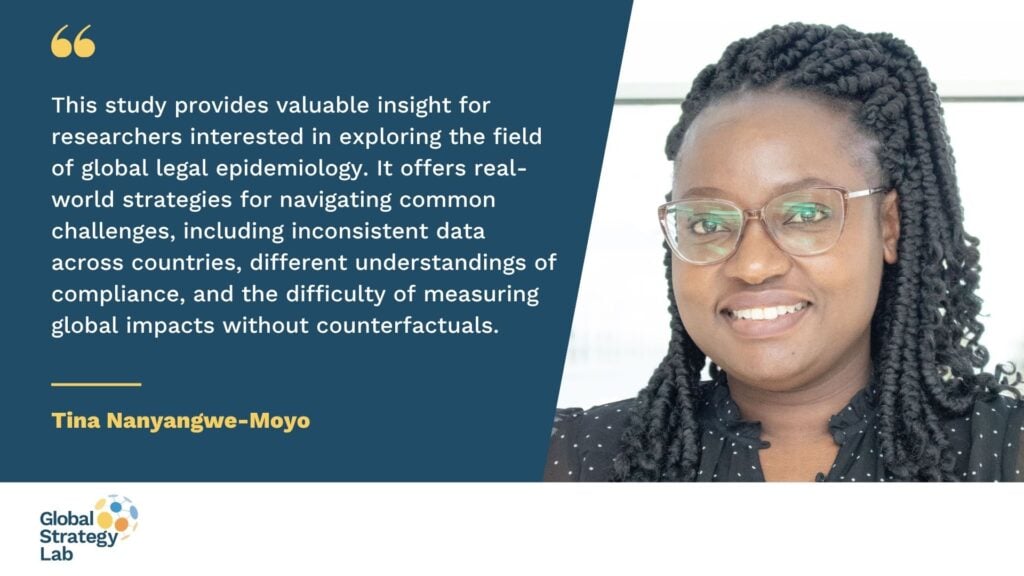
“This study provides valuable insights for researchers exploring the field of global legal epidemiology,” said lead author Dr. Tina Nanyangwe-Moyo. “It offers real-world strategies for navigating common challenges, including inconsistent data across countries, different understandings of compliance, and the difficulty of measuring global impacts without counterfactuals.”
This work builds on GSL’s 2023 paper, which defines why global legal epidemiology matters and how it differs from legal epidemiology. To learn more about this global legal epidemiology and how it’s been applied to other research across GSL, explore the program page or subscribe to the newsletter.
 Previous