

Global Health experts Steven J. Hoffman and Roojin Habibi provided commentary on travel bans, global governance, international law, health law, and human rights in response to the deadly Ebola outbreak devastating communities in the Democratic Republic of the Congo and Uganda.


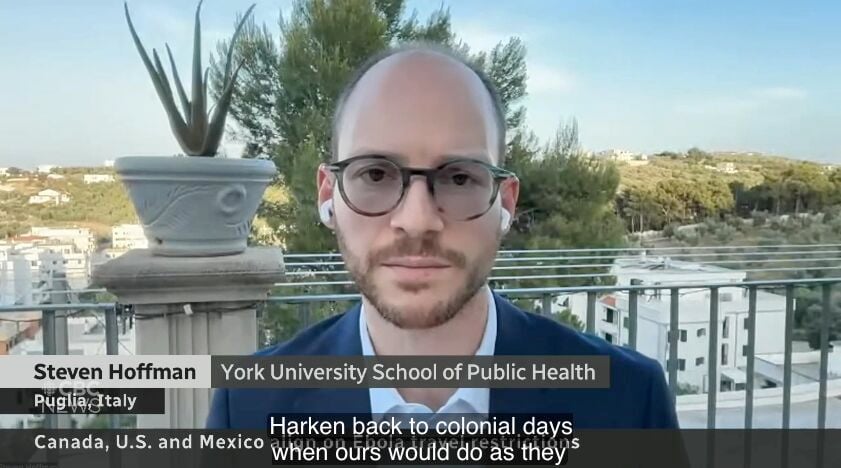
As travel bans emerged from Canada, the U.S., and Mexico ahead of the FIFA World Cup, GSL founder Steven J. Hoffman weighed in across several news outlets. Speaking with the Toronto Star, he noted how these measures might signal government action to the public, but may also cause harmful effects, like encouraging illegal methods of travel and making outbreak tracking harder. He also explained measures stigmatize people from affected countries and may discourage those countries from reporting future outbreaks. In a CBC News segment on the coordinated 90-day travel bans, he spoke to how the current international response echoes troubling colonial patterns. And in The Globe and Mail, he was quoted on the race to develop new Ebola vaccines and therapeutics, highlighting the important role of global health organizations during cross-border health emergencies.
GSL Global Health Law Research Director Roojin Habibi, who has contributed expert input to negotiation processes for the WHO pandemic instrument and amendments to the International Health Regulations, co-authored a commentary in The Globe and Mail with colleagues from the University of Ottawa’s Y.Y. Brandon (Yin Yuan) Chen and Jamie Liew. Responding to the federal government’s decision to suspend immigration processing for residents of Ebola-affected countries, the authors drew on their expertise in public health law, international law, and immigration law to argue that the measure is misguided, unsupported by scientific evidence, and inconsistent with Canada’s obligations under international law. They cautioned that the country has a long history of using discriminatory travel and immigration rules “for political theatre rather than public health,” and called for solidarity with affected countries in place of exclusion.
Habibi also brought this perspective directly to the press. In a Global News interview, she described the decision as driven more by political optics than by evidence, and in an interview with CBC News she argued that Canada should be signalling to the world that it is “a partner that will take science seriously,” while voicing concern for the people caught up in the immigration process, who she worried could be left feeling deprioritized.
Across both the travel-ban debate and the federal immigration response, GSL researchers have continued to offer evidence-informed perspectives grounded in international law and global health governance, the kind of cross-disciplinary expertise the Lab was built to provide.
 Previous